
AbSolution and ENCORE recognised with two Open Science awards
AbSolution [see also Github and CRAN] and ENCORE have received recognition through two Open Science awards for their contribution to accessible, transparent and reproducible computational research. Rodrigo Garcia Valiente developed AbSolution. Most recently, the project was selected by the Open Science Community Amsterdam jury for an OSCAward 2026 in the Transparency / Metascience / Preregistration / Reproducibility category. This award highlights the project’s use of ENCORE as a proof of concept for automating computational reproducibility in interactive applications, as well as its attention to accessibility for broader audiences and user needs, including colorblind-friendly visualisation.

This follows recognition at the first edition of the Amsterdam UMC Open Science Awards in 2025, where four outstanding projects from across Amsterdam UMC were selected to receive an award for their Open Science efforts. AbSolution and ENCORE were recognised for showing how interactive scientific software can combine usability, openness and accesible computational reproducibility.
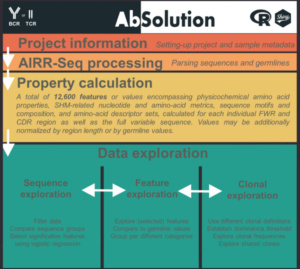
AbSolution is an open-source R Shiny application for the analysis of adaptive immune receptor repertoire sequencing data. It enables researchers, including clinicians, immunologists and experimental scientists without programming expertise, to explore complex immune sequencing datasets through an interactive interface. ENCORE complements this by guiding the capture of the full analytical provenance of computational work, including data, code, parameters, software environment, figures, reports and documentation, allowing analyses to be re-executed and independently checked. In the case of AbSolution, this reproducibility workflow was independently validated through the CODECHECK initiative, which confirmed that the exported analyses could be re-run by a third party without modification.
Together, AbSolution and ENCORE demonstrate that interactive analysis tools do not have to choose between accessibility and reproducibility. The project combines open-source software, reproducible research compendia, accessibility-oriented design and independent validation, providing both a practical tool for immune repertoire analysis and a reference implementation for reproducible interactive applications in other data-intensive fields.
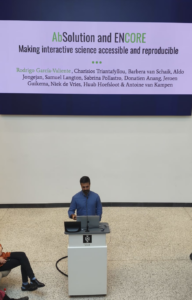
The OSCAwards ceremony took place on 15 June 2026, 17:00–19:00, at the Chirurgisch Theater, University Library of Amsterdam.
More information of this edition is available here: https://osc-international.com/inosc/oscawards-2026-highlights/