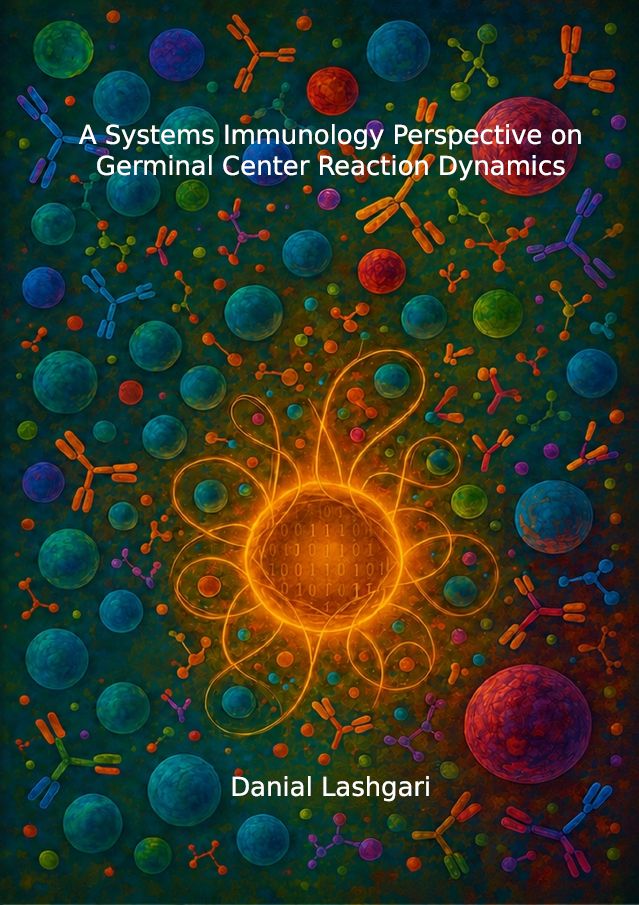

Danial Lashgari defended his PhD thesis A systems immunology perspective on germinal center reaction dynamics on 21 September 2026 in the Agnietenkapel in Amsterdam. Congratulations, Danial, on this fantastic achievement and an excellent defense!
Germinal centers are small structures in lymph nodes where B cells multiply, mutate their antibody genes and compete for antigen, so that the immune system gradually produces antibodies that bind more strongly to a pathogen. The selected B cells leave the germinal center as long-lived memory B cells or as antibody-secreting plasma cells. In his thesis, Danial used computational multiscale modelling to study how this germinal center reaction unfolds over time.
He extended an agent-based model of the germinal center with probabilistic antigen collection, which showed that the binding kinetics between B cell receptors and antigen may influence which B cells are selected, and that the amount of antigen affects both the number and the affinity of the cells leaving the germinal center. He then embedded a core gene regulatory network (BCL6, IRF4 and BLIMP1), described by ordinary differential equations, inside every simulated B cell to model plasma cell differentiation and asymmetric cell division. This multiscale model suggests that affinity-dependent CD40 signalling, together with asymmetric division, drives the shift from memory B cell to plasma cell output, and that BLIMP1, rather than asymmetric partitioning of antigen alone, plays a key role in this cell fate decision.
Finally, building on lessons learned during his PhD, Danial contributed to ENCORE (ENhancing COmputational REsearch), a framework to improve the reproducibility of computational research.
Supervisor: A.H.C. van Kampen. Co-supervisors: M.J. van Gils and H.C.J. Hoefsloot.
UvA-DARE (Digital Academic Repository)